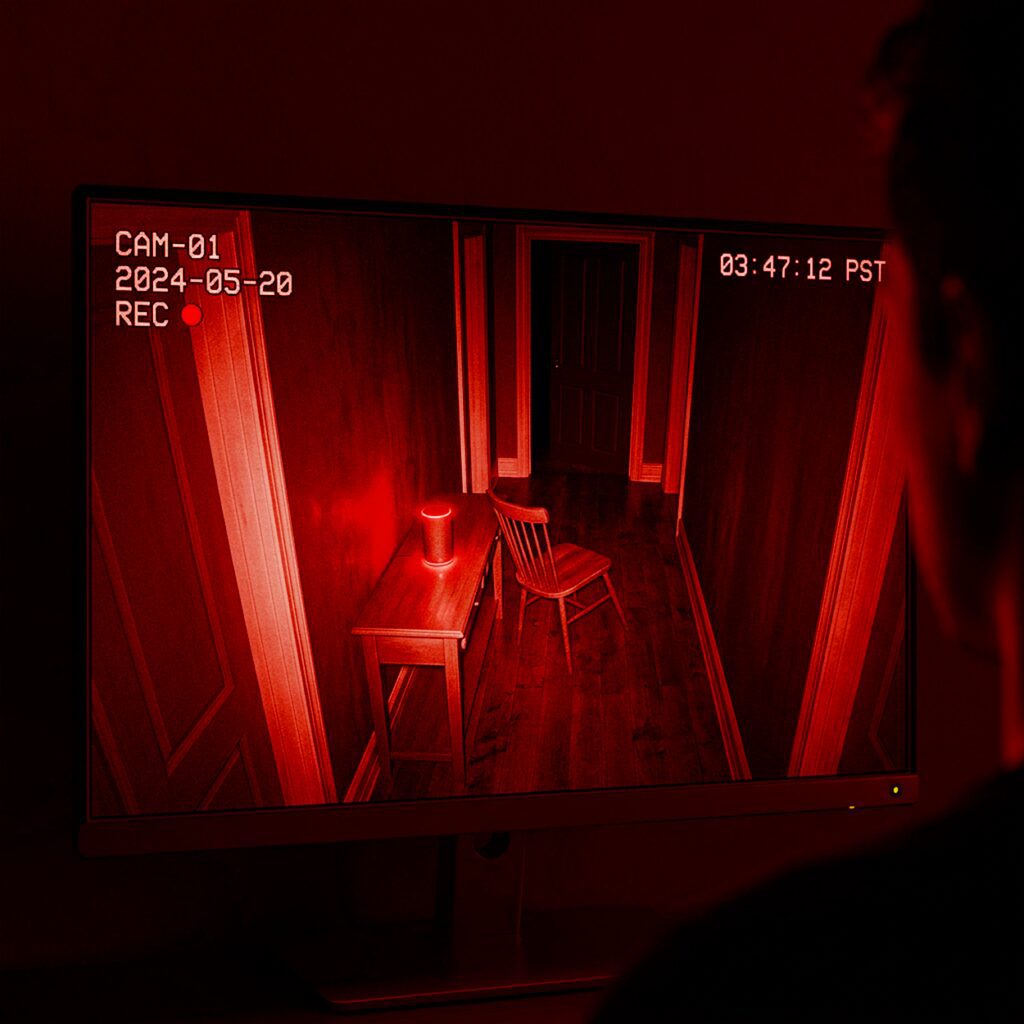
In February 2024, a Wyze customer logged into the company’s mobile app and saw the live feed from a stranger’s living room. Then a stranger’s kitchen. Then a child’s bedroom in another house. Wyze later confirmed the incident affected around 13,000 of its users during a third-party caching outage. The company called it a “thumbnail caching glitch”. The customers who had been watched, and the customers who had done the watching, called it something else.
That is the texture a smart home thriller needs in 2026. Not a hypothetical “what if your devices were watching you”, but the receipt: the date, the vendor name, the corporate statement that calls a privacy breach a glitch.
Always Home opens in this register. Nora Wells lives in a converted Adelaide Hills cottage wired up by a previous tenant who installed everything cheap, everything cloud-tethered, everything still receiving updates from servers she has no control over. She is not paranoid at the start. She has a Ring doorbell, a Hue lighting kit, and a Google Nest thermostat she replaces in chapter three. The novel does not invent its threat surface. It reads off the box.
Why the genre works now
For a long stretch of the 2010s, the smart home thriller was a forecast. Books like The Circle and the Black Mirror hour Be Right Back were pointing at where consumer technology was going. The fear was speculative, and the genre had to do the work of convincing the reader that the threat was plausible.
In 2026, that work is done. The reader bought the doorbell. The reader has the smart speaker on the kitchen counter. The reader has, at some point, said out loud “I think it’s listening” and then made a joke of it.
Three things changed.
The first is consolidation. The smart home market sorted itself into a small number of cloud-tethered platforms: Amazon Alexa, Google Home, Apple HomeKit, Samsung SmartThings, and Matter as the inter-operability layer trying to bridge them. A vulnerability in one platform can affect tens of millions of households. When Mirai infected an estimated 600,000 IoT devices in late 2016 and used them to take down the DNS provider Dyn for several hours, the world briefly lost access to Twitter, Reddit, Spotify, and Netflix. The 2016 incident was DVRs and IP cameras. The 2024 successor will be whatever is currently most-shipped.
The second is the news cycle. In the past five years, the press has run substantive reporting on Eufy contradicting its own local-only marketing, on Ring’s data-sharing arrangements with US police departments, on Wyze’s repeated camera-mismatching incidents, on Amazon Echo devices retaining audio fragments captured during accidental wake events. Each of these is a story the reader has filed somewhere. The thriller’s job is to remind them of the file.
The third is the texture of installation. Most readers did not deliberately build a smart home. They added one device, then another, accepted a default during a router setup, and forgot. The result is a household whose attack surface even the householder cannot inventory. A novel that opens with a character trying to remember whether the bathroom heater is wifi-enabled is reflecting the actual experience of the reader, not exaggerating it.
What the thriller can do that the news cannot
A news article ends. A novel keeps the reader in the house.
The smart home is unusually well suited to the thriller because the threat is environmental rather than encountered. A character does not run into the antagonist on page 47. The antagonist is the room. The Hue strip in the kitchen, the doorbell with a five-second buffer, the speaker on the bedside table with the LED ring that signals “listening” but does not signal “transmitting”. The tension is sustained because the character cannot leave the threat surface without leaving the home, and the home is where the genre is set.
This places the smart home thriller in the domestic suspense lineage rather than the techno-thriller one. Tom Clancy wrote about state actors and weapons systems. The smart home thriller is closer to The Woman in the Window and The Couple Next Door: it is interested in the violation of private space, and the technology is the medium of that violation rather than its subject.
Always Home sits in this lineage. The book is about a woman who does not know what is in her own walls. The technology is precise, the corporate behaviour is recognisable, and the threat is measured in the kind of small details that accumulate before they alarm.
Where to start
For readers coming to the smart home thriller for the first time, three points of entry.
Start with Always Home if a Hue bulb in the corner of your bedroom has ever made you reach for the switch. The opening chapter is on the site as a free sample, and the book page covers the rest.
For where the book sits in the genre, the comparable-author roundup maps it against ten thrillers that share its concerns: domestic suspense, technological precision, women under surveillance.
For the questions that come up most often (why Adelaide, why three books, why no map of the cottage), the FAQ covers them. The Adelaide Hills setting page covers the geography.
Books 2 and 3 in the ALWAYS series are scheduled for 20 May 2026 and 10 June 2026. Readers who want a note on release day can sign up to the Watch List.